Feet and Inches Calculator
Add, subtract, multiply and divide feet, inches and fractions the way they read off a tape measure. Type 12' 6-1/2", 150" or 3810 mm and get the answer in feet, inches and fractions, exact to 1/64, with the working shown. Free, no signup.
Your measurements
TIMES 3
21' 4-1/4"
A tape you can scroll back through, in the order you entered it, is in the app — along with memory registers and a keypad with ft, in and a/b on it.
total = a + b
Feet, inches and fractions do not add the way decimals do. The usual mistake is to add the feet to the feet and the inches to the inches, then forget the carry. This feet and inches calculator turns both measurements into inches, does the arithmetic there, and gives the answer in feet and inches with the fraction, and in decimal feet, decimal inches and millimetres. For the diagonal of a rectangle, or to check a corner for square, use the diagonal calculator.
How to add feet and inches
Convert both measurements to inches, add, then convert back. There are twelve inches in a foot each way. The carry is the step people drop: 8 ft 9 in plus 6 ft 5 in is 14 ft 14 in, which is 15 ft 2 in. A height works the same way: 5 ft 7 in plus 7 in is 5 ft 14 in, which is 6 ft 2 in. Fractions need a common denominator first, so 3/8 in plus 1/4 in is 3/8 plus 2/8, which is 5/8 in.
How to subtract feet and inches
When the inches you are taking away are more than the inches you have, borrow a foot as twelve inches. 10 ft 3 in minus 4 ft 8-1/2 in: 3 in is less than 8-1/2 in, so 10 ft 3 in becomes 9 ft 15 in. 15 in minus 8-1/2 in is 6-1/2 in, and 9 ft minus 4 ft is 5 ft, so the answer is 5 ft 6-1/2 in. A decimal and a fraction subtract the same way once both are inches: 14 in minus 13.6 in is 0.4 in, which is 3/8 in to the nearest sixteenth.
Feet and inches to inches, and back
Multiply the feet by twelve and add the inches. 5 ft 7 in is 67 in. Going the other way, divide by twelve: the whole number is the feet and the remainder is the inches, so 100 in is 8 ft 4 in. Every answer above shows both forms. A decimal foot is not an inch: 5.7 ft is 5 ft 8-3/8 in, not 5 ft 7 in, because 0.7 ft is 8.4 in. To turn decimal feet, decimal inches or millimetres into a tape mark, use the inches to fraction calculator.
How to multiply and divide feet and inches
Multiplying by a plain number scales a length: three courses of 7-3/16 in is 21-9/16 in. Dividing by a plain number splits one: a 10 ft run into three equal parts is exactly 3 ft 4 in, but into seven parts it is not a figure any tape carries, so the answer comes back rounded to your chosen resolution and marked with ≈ to say it is not exact.
Dividing by a length asks a different question: how many of those lengths fit. Type the divisor with its unit, 16" rather than 16, and the answer is a count with the leftover beside it. 20 ft divided by 16 in is exactly 15. 10 ft divided by 7 in is 17, with 1 in left over. The line under the field says which question it read.
How many 16 inch centers in a wall
Studs, joists and rafters are laid out at 16 in or 24 in on center. The count below is the number of whole spaces in the length. A layout with a stud at each end needs one more stud than spaces.
| Length | Spaces at 16 in | Left over | Spaces at 24 in |
|---|---|---|---|
| 8 ft | 6 | 0 | 4 |
| 10 ft | 7 | 8 in | 5 |
| 12 ft | 9 | 0 | 6 |
| 14 ft | 10 | 8 in | 7 |
| 16 ft | 12 | 0 | 8 |
| 20 ft | 15 | 0 | 10 |
| 24 ft | 18 | 0 | 12 |
| 30 ft | 22 | 8 in | 15 |
Every length on this chart divides evenly at 24 in. For any other length, set the operation to ÷ and type the spacing as 16".
Worked examples
5 ft 7 in plus 5 in is 6 ft 0 in. Seven inches and five inches make twelve, which carries to a whole foot.
5 ft 7 in plus 7 in is 6 ft 2 in. Fourteen inches is one foot and two inches.
12 ft divided by 16 in is 9. 144 in ÷ 16 in = 9, with nothing left over.
21 ft divided by 9 is 2 ft 4 in exactly: 252 in ÷ 9 = 28 in.
11 ft 5 in divided by 2 is 5 ft 8-1/2 in: 137 in ÷ 2 = 68.5 in.
132 in divided by 6 in is 22. Six-inch lengths fit twenty-two times with nothing left over.
17 in divided by 1/8 in is 136. There are eight eighths in an inch, and 17 × 8 = 136.
Sixteenths, thirty-seconds, and sixty-fourths
Set the resolution to the finest mark on your tape and every answer lands on a mark you can find. A framer works to a sixteenth, and a cabinetmaker to a thirty-second or finer. The arithmetic runs at full precision the whole way through and rounds once, on the way to the screen, so a sixteenth added sixteen times is exactly one inch.
Free online construction calculators
Each one answers its question in full, in the browser, with nothing blurred or locked. The app adds stair code reports, hips and valleys, and a tape that keeps every entry.
/CALCULATORS/ROOF-PITCH/
Roof pitch calculator
Convert any roof pitch to degrees, percent grade, slope ratio, and rafter factor. Add a run and it gives the rafter length.
/CALCULATORS/STAIRS/
Stair calculator
Riser height, tread depth, number of steps, total run, stair angle, and stringer length. Checks limits against IRC 2021.
/CALCULATORS/SQUARE-FOOTAGE/
Square footage calculator
Rooms, walls, floors, and irregular shapes. Enter feet and inches, get sq ft, sq yd, and sq m. Running total included.
/CALCULATORS/INCHES-TO-FRACTION/
Inches to fraction calculator
Convert a decimal inch, decimal feet or millimetres to the nearest mark on a tape, from 1/8 to 1/64, with the error shown.
/CALCULATORS/RIGHT-TRIANGLE/
Diagonal calculator
Find a diagonal, a missing side, or how far a corner is out of square, in feet and inches. The 3-4-5 rule, worked out.
Already know your pitch? The roof pitch to degrees chart lists every pitch from 1/12 to 24/12 with its angle, percent grade and pitch factor, and the roof pitch multiplier table gives the rafter, hip and valley multipliers.
Common roof pitches: 3/12, 4/12, 5/12, 6/12, 7/12, 8/12, 9/12, 10/12, 12/12.
Three things these calculators do differently
Exact fractions, not decimals
Fractions are carried at full precision and rounded once, on the way to the screen. A riser of 7-3/16 in is 7-3/16 in from the input to the cut, not 7.1875 rounded twice.
Shows the working
Every result opens into the named formula with your own numbers substituted into it. You can check the arithmetic by eye without trusting the tool.
Every code limit sourced
Code limits are printed with their section number and the margin. You always know which book a number came from and how close you are.
Download the Sawline app for the full jobsite tool
The website answers one question at a time. The app carries the roof and the stair: rafters, hips and valleys, stair stringers with code reports, and area and volume, and it works with no signal.
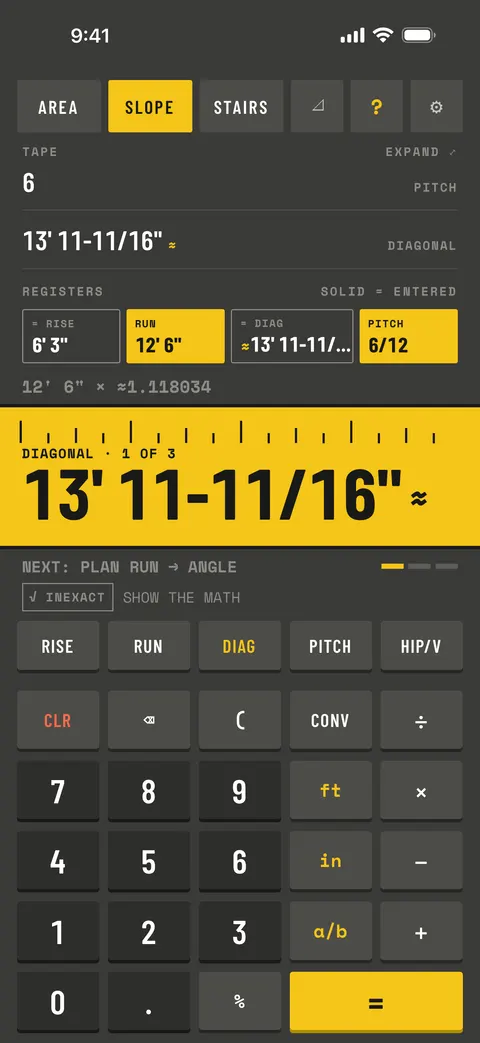
Roof pitch and rafters
Pitch to degrees, grade and ratio. Any two of rise, run, diagonal and pitch give the other two, and HIP/V gives the hip or valley.
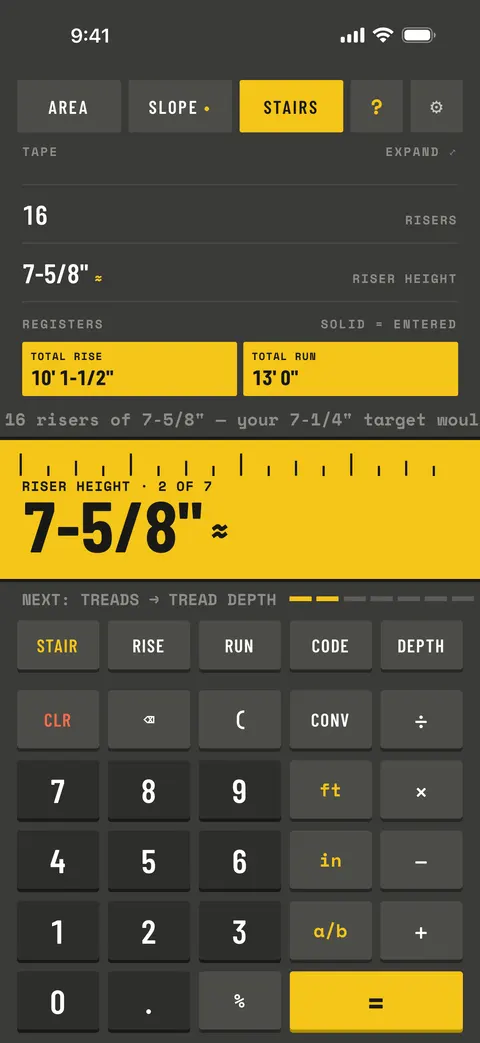
Stair layout and code check
One rise in, the whole flight out. The app sizes the stringer, checks each value against the ruleset, and prints the section number.
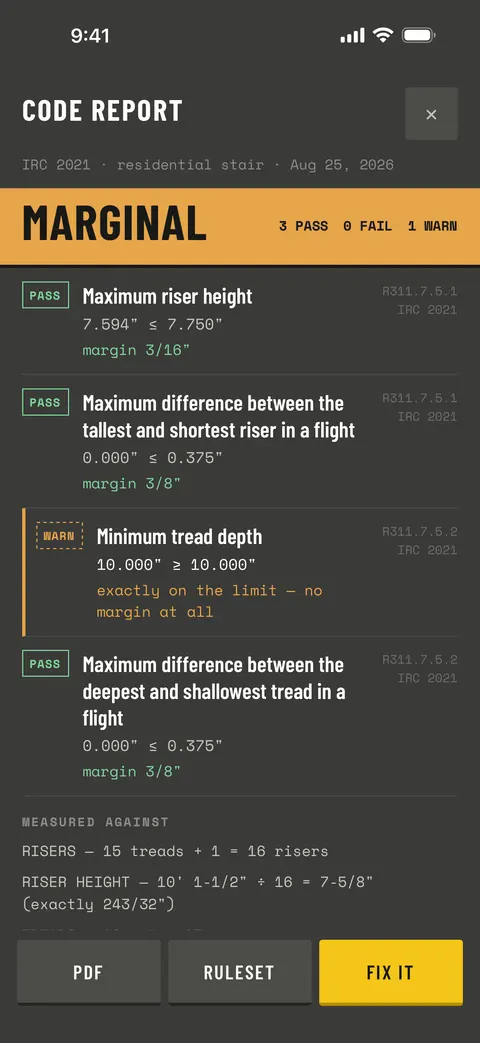
Code report with section numbers
Every row names the value, the limit, and the section it came from — including rows that pass. No guessing where a number came from.
What is in the app
Roofs, stairs, and area and volume in one app. $4.99/month (3-day trial), $24.99/year (1-week trial), or a $32.99 lifetime unlock. See prices and what is included.
Framing & roofing
Rafters, hips, valleys
Any two of rise, run, diagonal and pitch solve the other two. HIP/V gives the hip or valley length, its plan run, its angle and the backing bevel.
Stairs
Solved, then checked
Run-limited or riser-limited, with "it does not fit" treated as a real answer. Risers, treads, total run, and the stringer's length and angle.
Area and volume
Three dimensions in
Length, width and height give area and volume. A diameter gives a circle's area and circumference.
Built for the jobsite
Works with no signal
Everything runs on the device. Screen stays awake, keys sized for gloves, and an outdoor theme for bright sun.
Questions about feet and inches
How do you add feet and inches?
Convert both measurements to inches, add them there, then convert back — twelve inches to the foot going in and twelve out again coming back. The carry is the part people drop: 8 ft 9 in plus 6 ft 5 in is 14 ft 14 in, which is 15 ft 2 in. If the inches carry fractions on top, those need a common denominator before any of it happens.
How do you subtract feet and inches?
Convert both to inches, subtract, and convert back. By hand, borrow a foot as twelve inches when the inches will not go: 10 ft 3 in minus 4 ft 8-1/2 in becomes 9 ft 15 in minus 4 ft 8-1/2 in, which is 5 ft 6-1/2 in.
How do you convert feet and inches to inches?
Multiply the feet by twelve and add the inches. 5 ft 7 in is 67 in, and 12 ft 6-1/2 in is 150.5 in. The calculator shows the total inches for every answer, so the conversion never needs doing by hand.
How do you convert inches to feet and inches?
Divide by twelve. The whole number is the feet and the remainder is the inches, so 100 in is 8 ft 4 in and 256.25 in is 21 ft 4-1/4 in.
What is 5 feet 7 inches in decimal feet?
5.5833 ft. Seven inches is 7 ÷ 12 of a foot, which is 0.5833. Note that this is not 5.7 — a decimal foot is not an inch, and confusing the two is the commonest error on a drawing.
How do you multiply feet and inches?
Take the measurement to inches, multiply by the plain number, and convert back. Three courses of 7-3/16 in is 21-9/16 in, or 1 ft 9-9/16 in. Set the operator to × and the second field takes the number rather than a second measurement.
How do you divide a measurement into equal parts?
Set the operator to ÷ and enter how many parts. A 10 ft run split three ways is exactly 3 ft 4 in; split seven ways it is not a figure any tape carries, so the answer comes back rounded to your resolution and marked with ≈ rather than presented as exact.
How many 16 inch centers are in 20 feet?
Fifteen spaces, exactly. 20 ft is 240 in, and 240 ÷ 16 = 15 with nothing left over. With a stud at each end, that is 16 studs. Set the operation to ÷ and type the divisor as a length, 16", and the answer comes back as a count with the leftover shown.
Can Excel add feet and inches?
Not directly. Excel has no fraction type, so 12' 6-1/2" is either text it cannot add or 12.541666… it can. A custom number format will display feet and inches but it will not add them, which is why the formula people pass around for this is several nested functions long and still loses a sixteenth.